


The Bolje Sestre karst spring has been supplying potable water to the entire Montenegrin Coast since 2010, representing one of the largest water supply projects completed in the entire Mediterranean Basin over the last 50 years. The considerable depletion of spring discharge that occurred in the meantime required multidisciplinary research aimed at conceptualising and properly characterising this aquifer system and stabilising the capacity of the source. Research included carefully selected methods to explain a very complex recharge-discharge mechanism, which included hydrogeological mapping, tracing tests, hydrochemistry, isotopic analyses, simultaneous hydrometry on rivers in karst, groundwater budgeting, hydrodynamic analyses. The results indicate a dual recharge mechanism: (1) “winter” recharge consisting of dominantly autogenic recharge occurring within the karst aquifer, and (2) “summer” recharge in the dry season when supplementary allogenic recharge from the adjacent alluvial aquifer and rivers becomes active. It has been found that the main cause of spring discharge depletion is the unsustainable excavation of alluvial sediments from the riverbed and banks, which disturbs hydraulic connections and reduces the recharge to the composite alluvium-karst aquifer system. The results of the research have been published in Hydrogeology Journal https://doi.org/10.1007/s10040-025-02982-4
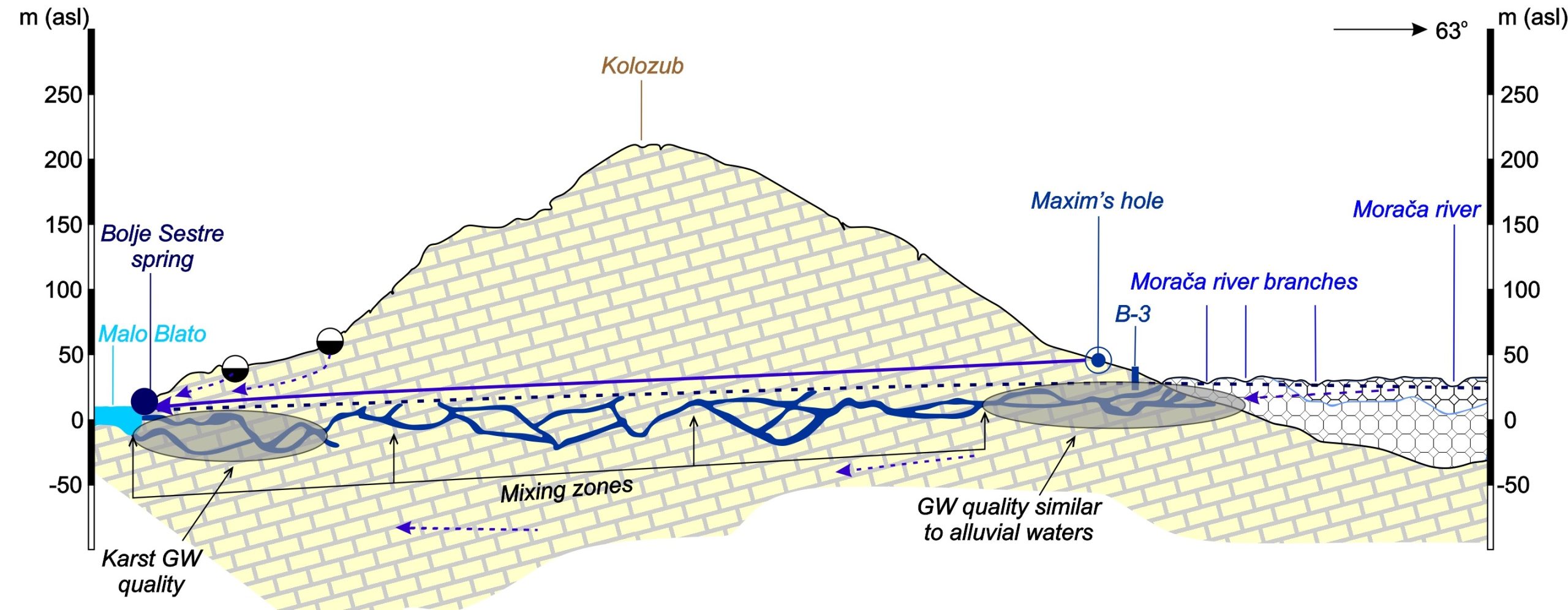
Cross-section of Morača River – Bolje Sestre spring and the hydrochemical zonation in the composite alluvium-karst aquifer system


